
Advancements in Monofocal IOL Technology
In this episode, Dr. Schallhorn discussed a retrospective study assessing the visual and refractive outcomes after implantation of the CT Lucia 621P (ZEISS).1
The CT Lucia 621P is an optimized non-constant aberration-correcting monofocal IOL that features negative spherical aberration in the center that gradually reduces to zero aberration in the periphery. According to Dr. Schallhorn, the unique design makes the lens highly tolerant to decentration and tilt.
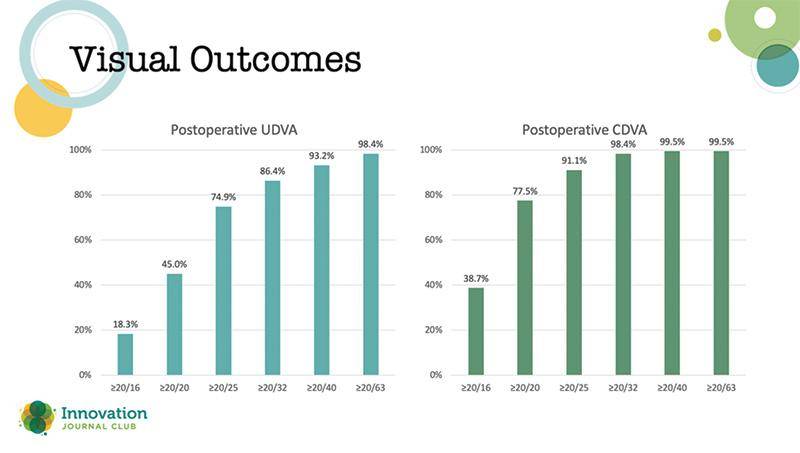
For the study, investigators reviewed early clinical outcomes and adverse events after unilateral or bilateral implantation of the CT Lucia 621P in 191 eyes of 133 patients.1 Results demonstrated the mean postoperative monocular uncorrected distance visual acuity (UDVA) was 0.09 ±0.16 logMAR (~20/25), and 74.9% (143 of 191) eyes achieved better than or equal to 20/25 UDVA (Figure 1). Additionally, the percentage of eyes with manifest spherical equivalent (MSE) within 0.50 D and 1.00 D of emmetropia was 84.8% (162 of 191) and 98.4% (188 of 191), respectively (Figure 2).


Reflecting on the trial data and the various ways in which new IOL monofocal advances continue to drive the field forward, Dr. Schallhorn noted that eye care professionals have come to understand that there are a lot of nuances to the optical system of the eye.
“There's a lot of nuances to the lens, such as how it goes in and how it sits. The optical properties of that lens can all be optimized to really improve the quality of vision for our monofocal IOL patients,” she concluded. “Every patient deserves the best possible outcome. Whether that’s premium IOL or monofocal IOL, you want patients to get the best possible treatment.”
Ready to Claim Your Credits?
You have attempts to pass this post-test. Take your time and review carefully before submitting.
Good luck!
Recommended
 IJC Recap: Changes in MIGS Reimbursement, Monofocal IOL Technology, and Second-Generation Anti-VEGFs
IJC Recap: Changes in MIGS Reimbursement, Monofocal IOL Technology, and Second-Generation Anti-VEGFs
I. Paul Singh, MDI. Paul Singh, MD- IJC Recap: Changes in MIGS Reimbursement, Monofocal IOL Technology, and Second-Generation Anti-VEGFs
Examining Changes in MIGS Reimbursement That Affect Procedural Selection
Sahar Bedrood, MD, PhDSahar Bedrood, MD, PhD - IJC Recap: Changes in MIGS Reimbursement, Monofocal IOL Technology, and Second-Generation Anti-VEGFs
Second-Generation Anti-VEGFs in Age-Related Macular Degeneration
Carl D. Regillo, MD, FACS, FASRSCarl D. Regillo, MD, FACS, FASRS