
Real-World Evidence in Glaucoma
Despite their necessity, randomized, prospective studies are costly, time-consuming, and increasingly difficult to recruit patients for. In contrast, real-world evidence like retrospective analyses may not be the gold-standard, but if conducted well, they do provide valuable information about a treatment’s long-term safety and efficacy. Indeed, data from real-world studies “help to guide our decision-making process, but data doesn't dictate our decision-making,” said Joseph F. Panarelli, MD, in a recent episode of IJC.
Retrospective Review of the OMNI Surgical System
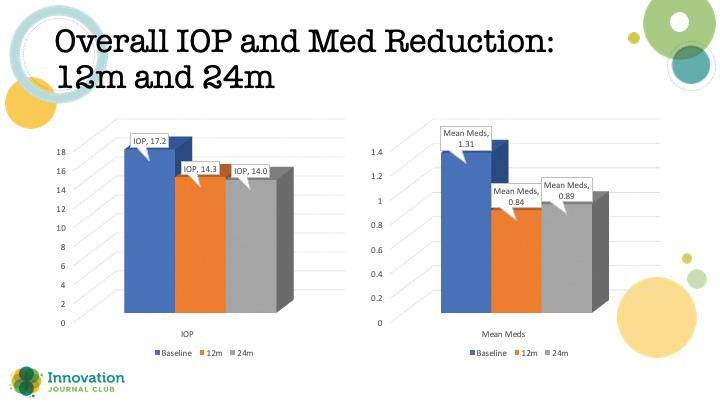
Dr. Panarelli joined Dr. Singh in reviewing glaucoma patients’ outcomes following canaloplasty and trabeculotomy that were performed with the OMNI Surgical System (Sight Sciences, Inc.) post-cataract surgery by a single surgeon. Yadgarov et al assessed IOP outcomes and medication usage at 12 and 24 months in 171 eyes of 171 consecutive patients, with results stratified by mild, moderate, or severe open-angle glaucoma.1 The researchers also noted whether a secondary surgical intervention (SSI) was required.
In the study, there was a significant reduction in both IOP and medication usage from baseline after OMNI surgery at both 12 and 24 months (Figure 1). Perhaps not unexpectedly, patients with mild or moderate glaucoma achieved greater medication reduction and the ability to avoid SSI compared to the severe group (Figure 2). “In some patients,” Dr. Singh said, “[MIGS surgery] may not have enough power to get them off medications, especially the more advanced they are. What I thought was interesting about this study was that the medication burden reduction was greater in the mild-to-moderate patients.”


IOP and Medication Changes Associated With the Xen Gel Stent
Dr. Panarelli also reviewed data from a systematic literature review of the Xen45 gel stent (Allergan, Inc./AbbVie) and its outcomes (postoperative changes in IOP and medication usage), and how outcomes correlated with patient demographics and other clinical factors.2 With an intentionally wide inclusion criteria to mimic an all-comers analysis, the researchers netted 111 studies. They found that the Xen45 implant was associated with a consistent reduction of IOP to the low-to-mid teens that remains stable as long as 36 months, and a frequent reduction in glaucoma medications. Furthermore, an analysis of IOP over time among studies reporting these data at interim time points demonstrated a predictable IOP-lowering effect in a pattern that mirrored the 12-month IOP data from Xen’s pivotal study in 2017 (Figure 3).3

In addition to the predictability of its outcomes, Dr. Panarelli likes the reproducibility and low risk of the Xen procedure. “It’s one of those procedures that I feel good about. When I am being a little extra aggressive, I feel like I’m not taking on too much risk for a lot of these patients.”
Ready to Claim Your Credits?
You have attempts to pass this post-test. Take your time and review carefully before submitting.
Good luck!
Recommended
 An Inside Look at Innovations in Ophthalmology—June 2024
An Inside Look at Innovations in Ophthalmology
I. Paul Singh, MDI. Paul Singh, MD- An Inside Look at Innovations in Ophthalmology—June 2024
Gene Therapy for the Retina
David Eichenbaum, MDDavid Eichenbaum, MD - An Inside Look at Innovations in Ophthalmology—June 2024
Innovation in Presbyopia Management
Mitchell A. Jackson, MDMitchell A. Jackson, MD