
Innovation in Presbyopia Management
Effectively addressing presbyopia may require a rethink of the mechanisms leading to loss of accommodative ability.
According to Mitchell A. Jackson, MD, a growing body of evidence suggests that models of accommodative ability focusing solely on movement of the ciliary body may be incomplete. Indeed, stiffening of the sclera in an aging eye and other extralenticular processes appear to be a major component in why patients lose the ability to focus at near as they age.
“The problem is there's cross-linking in the sclera, and it stops moving,” Dr. Jackson told Dr. Singh during a recent episode of IJC.
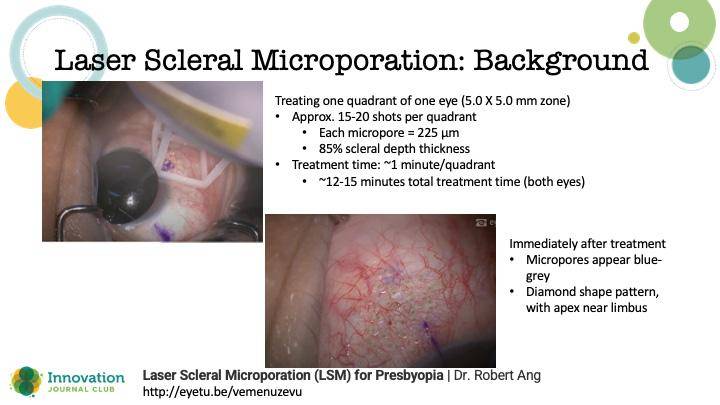
A novel treatment approach, known as laser scleral microporation (LSM), seeks to address presbyopia at its fundamental root cause. LSM describes a procedure in which an Er:YAG laser (VisioLite, Ace Vision Group) is used to create a diamond-shaped matrix of transconjunctival scleral micropores in four oblique quadrants (Figure 1). The procedure is performed bilaterally, and the goal is to un-crosslink the sclera.

“By weakening the sclera, we get everything moving again, so we actually restore our dynamic range of focus versus our true accommodation,” Dr. Jackson said.
Study Data
A recent study evaluated the dynamic range of focus at 24 months after bilateral treatments of LSM in 50 patients (average age = 52.6 years).1 The primary outcome was visual performance as assessed with ETDRS logMAR charts at distance, 60 cm, and 40 cm after 24 months.
In the study, no patient lost distance vision, intermediate vision was unchanged, and binocular distance-corrected near visual acuity had improved significantly by 24 months compared to baseline (Figure 2). “It's pretty amazing. It stays effective for at least 2 years, and it's at a level that matches anything we do with a premium lens and/or presbyopia eye drop that's been approved in the United States,” Dr. Jackson said.

As for the safety of the procedure with the current-generation laser (VisioLite, Ace Vision Group), moderate conjunctival vascularization and conjunctival edema may be evident on day 1 postoperatively, but these generally subside by week 1 (Figure 3). “This is really cosmetically acceptable. Eyes are white. Most patients are reading 20/40 or better uncorrected for near vision at day 1,” Dr. Jackson said.

Inclusion criteria for the study may offer some clues for patient selection, as patients were required to be using a reading add of at least 150+.
“You want people who are already in reading adds full-time and they're miserable,” Dr. Jackson explained. “I always call it the ‘LASIK-to-lens procedure.’ Most of the patients who undergo LSM are refractively oriented: they’ve had LASIK or whatever procedure to fix their distance, or if they're just an emmetrope, naturally born that way—what are you going to do until they get a cataract? You don't want to rush to intraocular surgery too soon in some of these patients, it might be a higher risk. With LSM, we have the perfect presbyopic or age-related treatment from that LASIK-to-lens procedure.”
While data collection is ongoing with the study, Dr. Jackson pointed out that Ace Vision Group is currently conducting trials with a next-generation laser that is coupled with an OCT device for even greater accuracy in achieving the desired scleral depth. The company is aiming to pursue a 510(k) approval for use of the next-generation laser in the United States.
Ready to Claim Your Credits?
You have attempts to pass this post-test. Take your time and review carefully before submitting.
Good luck!
Recommended
 An Inside Look at Innovations in Ophthalmology—June 2024
An Inside Look at Innovations in Ophthalmology
I. Paul Singh, MDI. Paul Singh, MD- An Inside Look at Innovations in Ophthalmology—June 2024
Real-World Evidence in Glaucoma
Joseph F. Panarelli, MDJoseph F. Panarelli, MD - An Inside Look at Innovations in Ophthalmology—June 2024
Gene Therapy for the Retina
David Eichenbaum, MDDavid Eichenbaum, MD