
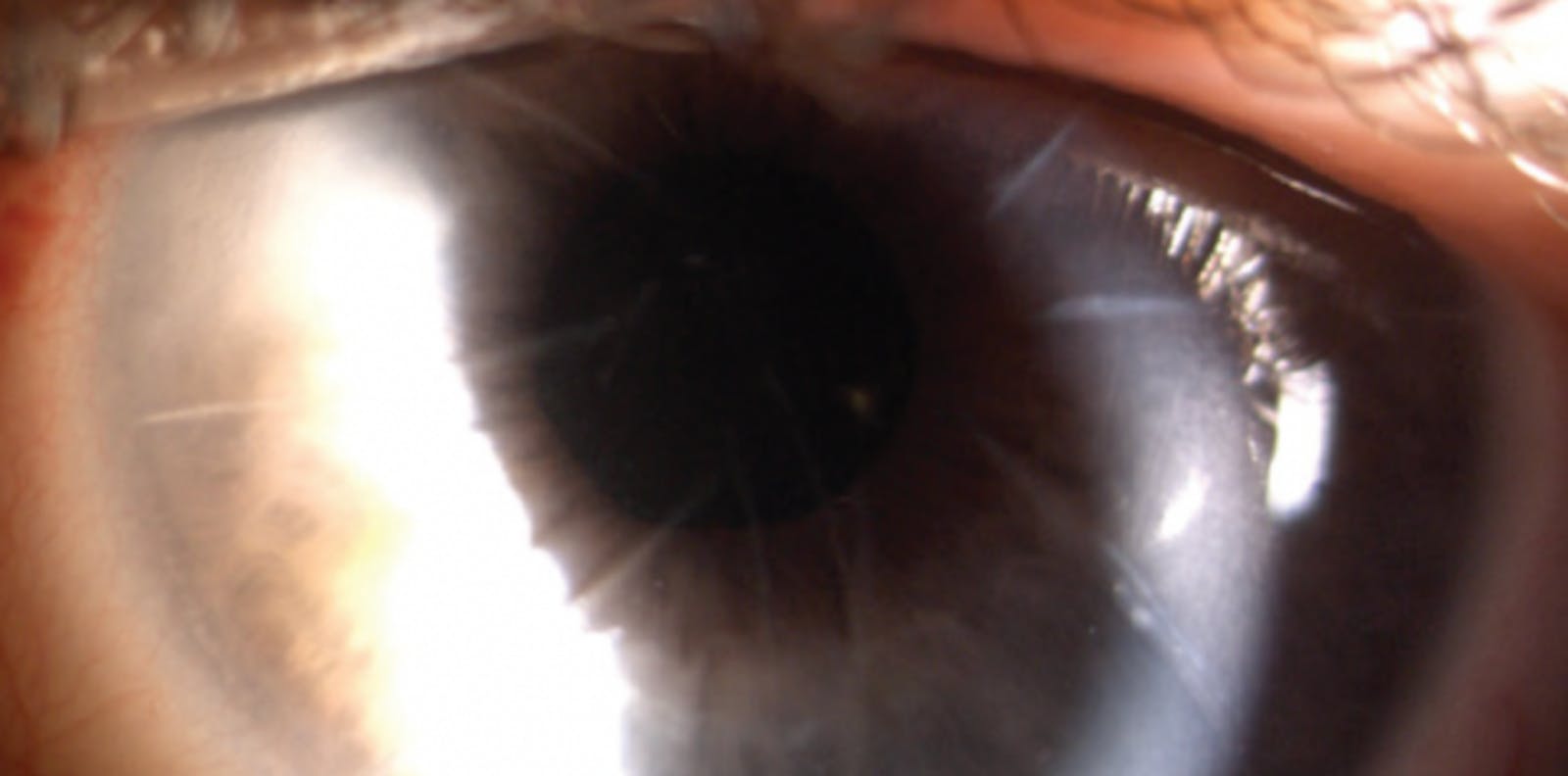


Light-Adjustable Lens in Eyes With a History of Radial Keratotomy
Webster M, Baartman B, Jones M, et al1
Industry support for this study: Multiple authors disclosed relationships with industry, including RxSight
ABSTRACT SUMMARY
This retrospective, consecutive case series evaluated visual and refractive outcomes with the second-generation Light Adjustable Lens (LAL; RxSight) in patients who had a history of radial keratotomy (RK). The study included 94 eyes of 77 patients; 26 eyes had four RK incisions, 11 eyes had six RK incisions, 52 eyes had eight RK incisions, and five eyes had 16 RK incisions. The first light treatment was delivered 6 to 8 weeks (mean, 49 days) after LAL implantation, and the final lock-in treatment occurred at 10 weeks on average (mean, 72 days). The eyes underwent 1.8 light adjustments on average.
Overall, 82% of eyes achieved 20/25 uncorrected distance visual acuity or better, and 74% achieved 20/20 uncorrected distance visual acuity or better. At final lock-in, 69% of eyes were within ±0.25 D of the refractive target, 88% were within ±0.50 D, and 98% were within ±1.00 D. The manifest refraction spherical equivalent was +0.05 ±0.40 D. Results were similar across RK cut patterns.
DISCUSSION
The results of this study indicate that the LAL can deliver accurate refractive outcomes in post-RK eyes. Refractive accuracy was defined as the difference between the target of the final light treatment and the refraction obtained after that adjustment. This method, previously described by Kozhaya et al, emphasizes whether the final lock-in refraction matches the target.2
STUDY IN BRIEF
A retrospective, consecutive case series evaluated visual and refractive outcomes with the second-generation Light Adjustable Lens (LAL; RxSight) in patients who had a history of radial keratotomy (RK). Most eyes achieved 20/25 uncorrected distance visual acuity or better, and 88% were within ±0.50 D of the targeted spherical equivalent at the final lock-in treatment. Delayed timing of the light adjustments appeared to be important for success.
WHY IT MATTERS
RK was commonly performed in the 1980s and early 1990s. As this patient population ages, a growing number of these individuals need cataract surgery, but IOL calculations are notoriously unreliable in this situation. The LAL improved refractive predictability by allowing adjustments after surgery, but several postoperative visits were required. The LAL, moreover, cannot correct corneal higher-order aberrations, which are common in post-RK eyes.
Refractive accuracy exceeded that typically reported with nonadjustable lenses. For instance, an earlier retrospective cohort study and literature review found that only 45.9% and 48.7% of post-RK eyes for which the Barrett True-K and Kane formulas were used achieved outcomes within ±0.50 D; 73.0% and 75.7%, respectively, attained results within ±1.00 D.3 Direct comparisons are not possible because the study populations differed. Nevertheless, the sizable difference in refractive accuracy reported in the two studies highlights the potential of the LAL to provide greater accuracy more consistently than even the IOL formulas that perform best in post-RK eyes.
Timing appeared to be key. Adjustments began at 6 to 8 weeks rather than the typical 3 to 4 weeks after LAL implantation. Given the slow stabilization of post-RK corneas, Webster and colleagues attributed the study outcomes in part to delaying the light adjustments. Despite concerns about lengthy treatment courses, a final lock-in treatment at approximately 10 weeks was reasonable.
Limitations of the study included its retrospective design and the lack of a control group. Additionally, the LAL does not address higher-order aberrations (HOAs) or corneal scarring. Screening with topography, tomography, HOA analysis, or a rigid gas permeable contact lens overrefraction can help distinguish lenticular from corneal blur. Postoperative quality of vision among patients with central corneal irregularity or scarring may be limited even if the refractive outcome is accurate.
Overall, this case series supported the LAL’s utility for cataract surgery on post-RK eyes.
Predicted Visual Impact of a Small Aperture Intraocular Lens in Reducing Higher Order Aberrations in Post-Radial Keratotomy Patients
van den Berg RM, DeVaro S, Rocha KM, Fetrin de Barros M, Klyce SD4
Industry support for this study: None
ABSTRACT SUMMARY
This study evaluated the potential impact of small-aperture optics (IC-8 Apthera, Bausch + Lomb) on corneal aberrations in post-RK eyes. A retrospective chart review of 32 eyes (4–16 RK incisions) of 23 patients used Scheimpflug tomography–derived HOAs to model the effect of corneal plane aperture diameters of 6, 4, and 2 mm. Data were extrapolated to estimate the average root mean square HOAs for a 1.6-mm aperture to approximate the IC-8’s 1.36-mm aperture at the IOL plane.
The average root mean square HOAs were significantly lower with the small aperture than with a natural photopic pupil size. In one case, the model predicted an approximately 90% reduction in corneal HOAs, and whole-eye testing revealed an approximately 70% to 75% reduction, showing good agreement.
DISCUSSION
The practical value of this study is its ability to test-drive the pinhole effect before surgery. RK corneas are highly variable, and those with central scarring or irregularity might not benefit from small-aperture optics. As van den Berg and colleagues noted, the IC-8 not only reduces peripheral aberrations but also increases depth of focus, effectively widening the refractive landing zone and improving the patient’s postoperative range of vision (as reflected by the single patient with improved distance and near vision). Trade-offs with the lens implant include reduced contrast sensitivity, limited correction of cylinder, and potential restriction of the peripheral retinal exam.
STUDY IN BRIEF
A theoretical modeling study evaluated the potential impact of small-aperture optics on corneal aberrations in eyes that had a history of radial keratotomy. A 1.6-mm corneal plane aperture mimicking the design of the IC-8 Apthera lens (Bausch + Lomb) was simulated in 32 eyes and consistently reduced predicted higher-order aberrations (HOAs). One clinical case confirmed the predicted effect, with the patient experiencing a 2-line increase in their corrected distance visual acuity.
WHY IT MATTERS
In eyes with HOAs, an IC-8 Apthera lens can improve image quality by filtering aberrant rays and extend depth of focus through the pinhole effect. Potential drawbacks include a reduction in contrast sensitivity and limitations on a retinal examination. Careful patient selection and counseling are essential. This study indicated that preoperative HOA modeling with either an aberrometer such as the OPD-Scan (Nidek) or iTrace (Tracey Technologies) or tomography-based software could help predict whether a small-aperture IOL would reduce HOAs, thus helping to identify the patients most likely to benefit from this technology.
Limitations of the study included a small, retrospective dataset and a largely theoretical analysis, with only one case that had measured outcomes. Additionally, as noted earlier, the 1.6-mm corneal plane aperture was an approximation of the IOL’s effect. These caveats highlight the need for prospective, real-world data.
It is also important to note that the IC-8 is US FDA-approved only for unilateral implantation. A prospective study found that bilateral implantation of the lens provided patients with good binocular function and improved their intermediate and near visual acuity with a minimal, nonsignificant loss of contrast sensitivity.5 That study cohort was small, however, and the design was nonrandomized with selection bias. At present, caution and careful counseling are warranted before bilateral implantation of an IC-8 Apthera lens.
One possible approach to select post-RK patients would be to implant an IC-8 Apthera lens in the eye with greater corneal irregularity and a precision lens such as the LAL in the contralateral eye. Reports on this strategy have been anecdotal thus far.
1. Webster M, Baartman B, Jones M, et al. Light-adjustable lens in eyes with a history of radial keratotomy. J Cataract Refract Surg. 2025;51(3):243-248.
2. Kozhaya K, Wang L, Weikert MP, Koch DD. Early outcomes of second-generation light-adjustable lenses in eyes with and without corneal refractive surgery. J Cataract Refract Surg. 2023;49(11):1180-1182.
3. Moshirfar M, Sperry RA, Altaf AW, Stoakes IM, Hoopes PC. Predictability of existing IOL formulas after cataract surgery in patients with a previous history of radial keratotomy: a retrospective cohort study and literature review. Ophthalmol Ther. 2024;13(6):1703-1722.
4. van den Berg RM, DeVaro S, Rocha KM, Fetrin de Barros M, Klyce SD. Predicted visual impact of a small aperture intraocular lens in reducing higher order aberrations in post-radial keratotomy patients. Vision (Basel). 2025;9(2):46.
5. Ang RE. Visual performance of a small-aperture intraocular lens: first comparison of results after contralateral and bilateral implantation. J Refract Surg. 2020;36(1):12-19.