


Cataract and refractive surgeons face a paradox: more premium IOLs are currently available than ever before, and choosing the best one for a given patient has never been more complex. This complexity has arisen not only from the rapid diversification of implant designs but also from a lack of consensus regarding how to evaluate them. Several classification systems have been developed. Each provides a different perspective, but none offers a complete picture.1-6
This article describes how a digital tool we developed can simplify IOL selection.
A FRAGMENTED CLASSIFICATION LANDSCAPE
The number of implant options has exploded, and the framework for understanding and comparing them has yet to catch up. Classification systems can be divided into four main groups.
No. 1: Optical Design–Based Categories
The conventional model classifies IOLs based on optical principles—monofocal, multifocal, extended depth of focus, and hybrid—that refer to mechanisms such as diffraction, refraction, wavefront shaping, and pinhole effect. This classification system is useful as a starting point but does not predict actual visual performance.
No. 2: Regulatory Standards
The American National Standards Institute (ANSI Z80.35:2018) and International Organization for Standardization (ISO 11979-7:2024) norms define criteria for labeling an IOL as extended depth of focus based on the intermediate visual acuity, depth of field, and maintenance of distance acuity provided by the lens. These standards are crucial for regulatory consistency, but their ability to reflect real-world performance is limited.
No. 3: AECOS Classification
The American-European Congress of Ophthalmic Surgeons (AECOS) framework was proposed to improve communication among clinicians and patients. IOLs are organized based on three axes: range of field, mechanism of action, and dysphotopsia profile. The AECOS model uses simple terms such as full range of focus (ROF) and monofocal plus to ease discussion.6 This classification system holds promise but is not widely used in routine clinical practice.
No. 4: ESCRS Functional Classification
The ESCRS model is functionally relevant and based on clinical defocus curves. Lenses are divided into two major groups: (1) partial ROF, with subcategories such as narrowed, enhanced, and extended and (2) full ROF, with further descriptions by curve profile such as smooth, steep, and continuous.1
The ESCRS classification system provides a nuanced view of IOLs’ clinical performance but does not currently include parameters such as dysphotopsia severity or pupil dependency, both of which play a key role in patient satisfaction.
DEPTH OF FOCUS VERSUS RANGE OF FIELD VERSUS RANGE OF VISION
Although the terms are often used interchangeably, depth of focus refers to the retinal tolerance around the focal point, whereas range of field or depth of field describes the object space where vision remains functional (eg, reading distance). This distinction is frequently misunderstood in clinical settings, and the terminology remains unclear in both the literature and ISO standards. Range of vision is recently coined marketing language that addresses the entire visual field visible to the eye, including depth of field and field of vision. Riaz et al highlighted the confusion surrounding the terms depth of field, depth of focus, and range of vision and suggested that depth of field may be the most clinically relevant term for patient communication.7
UNIFIED CLASSIFICATION
An ideal system would combine a unified database with an implant "identity card" (specification profile or product label) that includes the lens’ manufacturer and model, its technical profile based on AECOS terminology (mechanism of action, range of field, dysphotopsia profile), the ROF classification (such as the ESCRS model and potentially including the area under the defocus curve), and a pupil dependency index. Such a framework would allow more reliable comparisons and could enhance both clinical decisions and patient communication.
A STRUCTURED COMPANION FOR PERSONALIZED IOL SELECTION
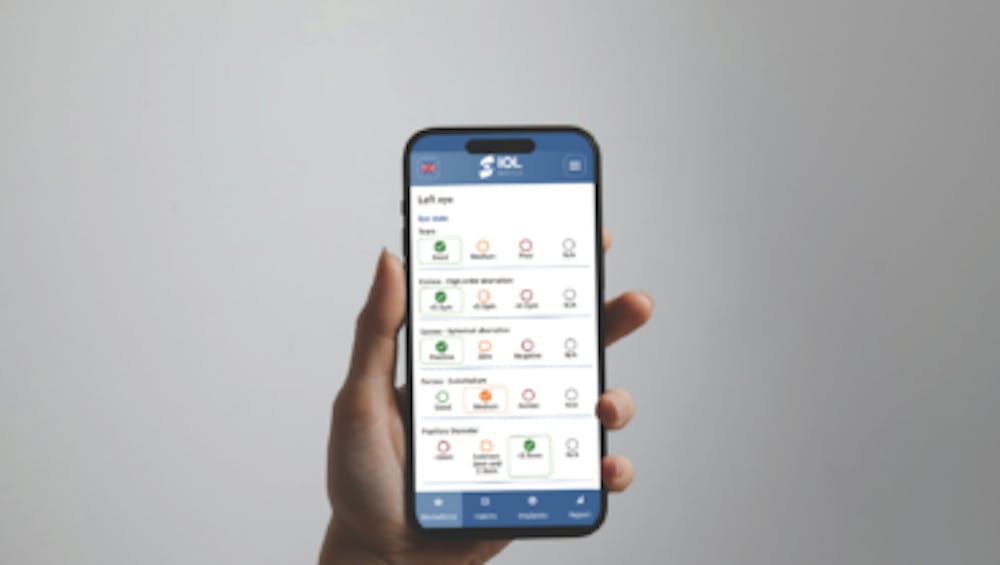
To help navigate the fragmented classification landscape, we developed IOL Match (Iridis Robotics; Figure), a tool designed to assist surgeons in selecting the most appropriate IOL for each patient. Rather than offer fixed recommendations, the platform supports individualized reflection by integrating clinical and subjective parameters.

Figure. IOL Match app.
IOL Match allows surgeons to do the following:
- Compare lenses based on visual performance metrics;
- Align IOL choices with the patient’s lifestyle, biometric data, and priorities;
- Enhance patient communication through clear visual tools and side-by-side comparisons; and
- Support postoperative tracking through the planned integration of patient-reported outcome measures and patient-reported experience measures in the future.
By providing a common language for surgeons and patients, the tool facilitates more informed, confident, and collaborative decisions, especially in situations with complex expectations or borderline indications.
WHAT IS NEW AND WHAT IS COMING
IOL Match has evolved significantly since the publication of our first article about the tool in CRST a year ago.8 One update allows it to support simulations involving secondary sulcus-fixated lenses, which can be particularly useful in cases of refractive surprises. These lenses are often combined with a primary IOL implanted in the capsular bag to refine the final refractive outcome.
The platform’s responsiveness has also been improved based on user feedback, and minor technical bugs have been addressed. IOL Match is free for download through the Apple App Store and Google Play, allowing surgeons to use it easily in consultation or in various clinical settings.
The next step in development is the implementation of a prepopulated visual habits questionnaire to be sent to patients automatically before biometric assessments. This would allow them to respond at home and save time during preoperative visits. We are also developing automated modules for collecting patient-reported outcome and experience measures to close the feedback loop and enhance long-term outcome tracking.
CONCLUSION
The need for clear, structured, patient-centered decision-making tools increases as the number and complexity of premium IOLs grows. IOL Match can help bring coherence to a fragmented classification landscape by connecting evolving systems with real-world patient scenarios. As of June, the product had nearly 400 users internationally. With continued refinement and the integration of patient feedback tools, IOL Match could foster a more personalized and transparent approach to presbyopia correction.
1. Ribeiro F, Dick HB, Kohnen T, et al. Evidence-based functional classification of simultaneous vision intraocular lenses: seeking a global consensus by the ESCRS Functional Vision Working Group. J Cataract Refract Surg. 2024;50(8):794-798.
2. Daya S, Mertens E, Carones F, Shahnazaryan D; AECOS Working Group on IOL Nomenclature. Comment on: Evidence-based functional classification of simultaneous vision intraocular lenses: seeking a global consensus by the ESCRS Functional Vision Working Group. J Cataract Refract Surg. 2025;51(5):436.
3. Ribeiro F, Dick HB, Kohnen T, et al. Reply: Evidence-based functional classification of simultaneous vision intraocular lenses: seeking a global consensus by the ESCRS Functional Vision Working Group. J Cataract Refract Surg. 2025;51(5):437.
4. Fernández J. Functional classification of multifocal IOLs. Cataract & Refractive Surgery Today Europe. February 2021. Accessed September 10, 2025. https://crstodayeurope.com/wp-content/uploads/sites/5/2021/02/0221CRSTEuro_cs_FernandezONLINEONLY.pdf
5. Rampat R, Gatinel D. Multifocal and extended depth of focus IOLs. CRST Global. February 2021. Accessed September 10, 2025. https://crstodayeurope.com/articles/feb-2021/multifocal-and-extended-depth-of-focus-iols
6. Ambati B, Daya SM, Trinh T. Standardizing terms in cataract and refractive surgery. Cataract & Refractive Surgery Today. March 2023. Accessed September 10, 2025. https://crstoday.com/articles/mar-2023/standardizing-terms-in-cataract-and-refractive-surgery
7. Riaz KM, Wendelstein JA, Koch DD. Depth of field or depth of focus? J Cataract Refract Surg. 2024;50(12):1291-1292.
8. Lesieur G, Dupeyre P. A data-driven application for personalized IOL selection. Cataract & Refractive Surgery Today. November/December 2024. Accessed September 10, 2025. https://crstoday.com/articles/nov-dec-2024/a-data-driven-application-for-personalized-iol-selection