


In an episode of the Innovation Journal Club, Denise M. Visco, MD, MBA, shared insights into the evolving role of femtosecond laser arcuate incisions in astigmatism correction during cataract surgery.
Dr. Visco emphasized the benefits of using beveled arcuate incisions created by the ALLY laser (LENSAR), which differ from traditional corneal-plane incisions and which she believes offer enhanced stability. “Our data show that when paired with a reliable nomogram, the results remain stable, even at 24 to 36 months postop,” she noted, referencing her multi-year studies.1 This long-term efficacy, she said, dispels concerns about regression in visual outcomes.
One standout feature of the LENSAR system is its iris registration capability. By aligning laser treatments with topographic data rather than relying on manual or limbal vessel markings, the system ensures highly accurate incision placement. Dr. Visco stressed the importance of consistency: “If you’re going to make a nomogram that consistently delivers the same result, then formation and placement of the incision are critical.”

She also addressed a common mistake among surgeons—deliberately leaving incisions unopened to “titrate” results. “You can’t titrate these. The incision either is or it isn’t. If you’re unsure of the outcome, you should reevaluate your treatment plan,” she advised.
During the episode, Dr. Visco shared data from a retrospective chart review of 22 patients who had undergone femtosecond laser arcuate keratotomy for astigmatism correction using the ALLY laser. The study sought to evaluate the long-term stability of the laser’s astigmatism correction by comparing postoperative data at 4 to 6 weeks and at 24 to 36 months.1 According to Dr. Visco, the study validated the stability of the incisions (Figure 1). Refractive outcomes are shown in Figure 2.
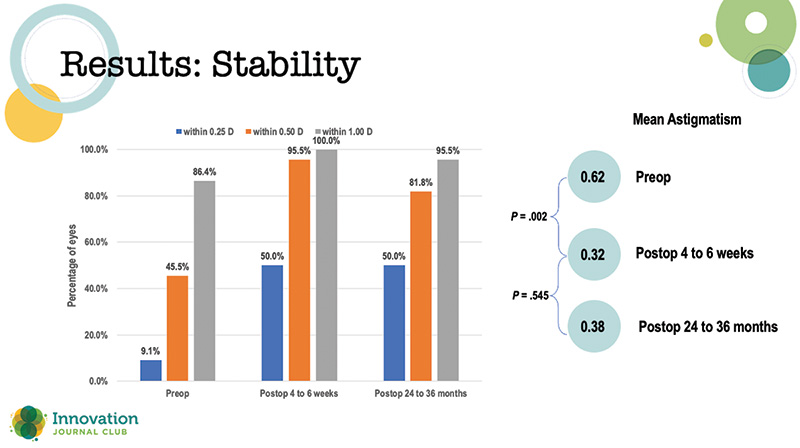
Figure 1. A retrospective chart review of 22 patients found that arcuate incisions created at the time of cataract surgery with the Lensar ALLY laser were stable when outcomes were examined at 4 to 6 weeks postoperatively and again at 24 to 36 months postoperatively.

Figure 2. Refractive outcomes at 4 to 6 weeks postoperatively and at 24 to 36 months postoperatively from Dr. Visco's retrospective chart review.
In conclusion, Dr. Visco encouraged surgeons to track their own data closely. “You can’t improve outcomes without knowing where you’re starting from,” she said. Her message was one of optimism grounded in science—precision tools, when correctly applied, yield reliably excellent results.
1. Visco DM. Long-term Stability of arcuate incisions created with a novel, dual pulse femtosecond laser system for astigmatism management. Presented at: American Society of Cataract and Refractive Surgery. April 25-28, 2025; Los Angeles.